


In sync with global trends, the Indian market for ductile…
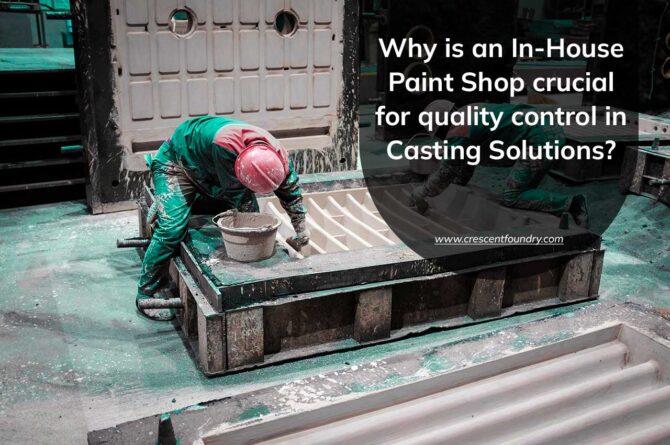
Why is an In-House Paint Shop Crucial For Quality Control in Casting Solutions?
Quality control is not a single checkpoint for the casting industry. It is a continuous process that spans every stage of manufacturing. When we are talking particularly about the casting solutions, we need to understand that the quality of the casting components does not solely rely on dimensional accuracy and internal strength. Surface treatment, especially the painting, plays a decisive role in ensuring the final product performs under real-world conditions. This is where the value of an in-house paint shop becomes evident.
An in-house paint shop is an essential part of the casting industry, and it provides considerable benefits to both the durability and aesthetics of castings. The paint shop provides a protective finish that protects the finish of surfaces from corrosion, wear, and general exposure to the environment.
The paint finish that the casting solutions paint shop offers not only serves a protective purpose but also enhances the component’s appearance and facilitates cleaning and upkeep. Let’s examine how integrated manufacturing offers major benefits and how this in-house arrangement helps improve quality control.
How Does An In-House Paint Shop Enhance Quality Control In Casting?
Cast metal surfaces are often prone to corrosion and other degradation of surface quality. When a coating is properly applied, it offers the needed protection to the component, leading to a lasting lifecycle and exposing the components to specific requirements.
An in-house paint shop for casting solutions allows for instant visual and dimensional inspection of components both before and after painting. The team can find and fix flaws like porosity or poor masking instantly through this.
An in-house paint shop provides manufacturers with complete control over:
- Paint and paint composition
- Application process (spray, dip, powder coat, etc.)
- Coating thickness
- Curing drying cycles
Each of these influences the quality and consistency of the final surface. An outsourced paint shop vendor may not be able to maintain the same stringent tolerances of the casting components.
Transferring raw or semi-finished castings to third-party paint shops exposes the castings to contamination, moisture ingress, or physical damage during handling. Having an in-house paint shop eliminates this issue and improves surface preparation and maintains cleanliness to ensure finishes are defect-free.
Also Read: Understanding the Role of Different Metals in Counterweight Manufacturing
Application of paint is sensitive to environmental conditions such as temperature, humidity, and cleanliness, so having an in-house paint shop facility can lead to optimised paint application with controlled environments such as dust-free booths, humidity controls, and ventilation systems.
This ensures optimum curing and uniform coating, particularly important for components used in demanding industries like automotive and heavy machinery.
If issues develop during the painting process, such as poor adhesion or inconsistent coverage, the issue can be immediately addressed. If paint shops are off-site, this responsiveness of fixing problems is impossible.
The Advantages Of Integrated Casting, Painting, And Machining Under One Roof
Having the three facilities (casting, painting, and machining) under one roof creates an operational advantage.
1. Quicker Turnaround Time and Delivery
By minimising transportation time and scheduling work with vendors, businesses are able to reduce overall production cycles. This operational efficiency leads to less time to meet deadlines while increasing capacity for production without impacting quality.
2. Reduced Costs
Investing in a sustained and continuous in-house paint shop for casting solutions is a significant investment; however, it has the potential for variable cost savings over the long-term:
- No more vendor costs for outsourcing
- Reduced vendor transit costs and packaging costs
- Reduced rejections and rework
- Improved labor and energy utilisation
3. Improved Coordination of Processes
Co-ordination of processes was made easy by the simple fact the teams for casting, machining and painting are located directly beside one another. This generates rapid iterations of designs, or replacements, and designs for improvement in quality. This is a stronger collaborative process that supports closure and a continuous improvement process.
4. Improved Space and Inventory Utilisation
A structured operation with integrated logistics uses less buffer stock of materials and less warehouse space to store materials waiting for painting or machining. so, an in-house paint shop reduces logistics planning and nonproductive warehousing cost of operations while creating an operationally collaborative and more effective approach to inventory utilisation.
5. More customisation and flexibility in manufacture
Timing for paint can be flexible to a customer’s needs when there is an in-house paint shop available for casting solutions.
6. Better Traceability & Compliance
An in-house paint shop has better traceability with coating materials, batch records, environmental compliance, and quality certifications during traceability and audits from customers.
Conclusion
The painted finish in casting manufacturing is not just purely aesthetic; it is an essential component of product integrity. The paint layer is significantly important for product performance and perception, ranging from corrosion protection to surface finish, compliance with regulatory requirements, and end-use value.
Establishing an in-house paint shop for casting solutions offers measurable benefits: quality control, reduced risk, and more efficient production. When casting, machining, and painting occur at the same facility, the entire manufacturing process is faster and less uncertain.
FAQs
Q. Why is an in-house paint shop important for quality control in casting solutions?
Answer: It ensures consistent surface protection, immediate defect correction, and optimal environmental conditions for coating.
Q. How does having casting, machining, and painting under one roof benefit production?
Answer: It reduces turnaround time, lowers costs, and improves coordination between processes.
Q. What operational risks are avoided by using an in-house paint shop instead of outsourcing?
Answer: It eliminates contamination, damage during transport, and loss of control over coating quality.