



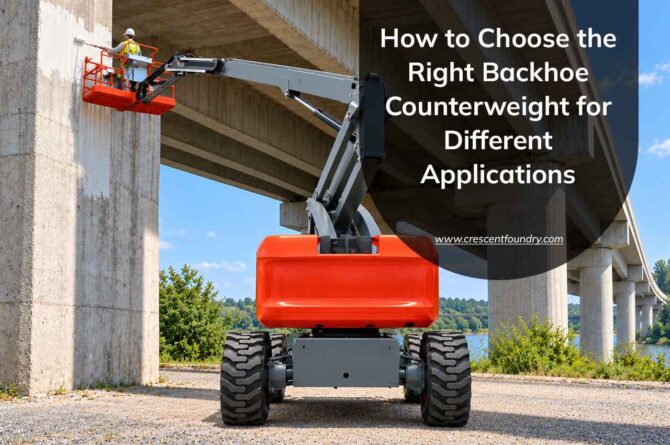
How to Choose the Right Backhoe Counterweight for Different Applications
A backhoe loader performs a wide range of construction activities, including excavation, trenching, loading, and material handling. Maintaining the machine’s intended weight distribution is important for safe and efficient operation. Depending on the equipment configuration, a properly specified backhoe counterweight helps balance operating loads and supports machine stability during designated tasks.
Selecting the right backhoe counterweight requires consideration of the machine model, manufacturer specifications, attachment configuration, operating requirements, and mounting compatibility. The counterweight must support the equipment’s intended balance without exceeding specified weight or axle-load limits.
Understanding these factors can help equipment manufacturers and component buyers evaluate counterweights for different applications.
What Is a Backhoe Loader Counterweight?
A backhoe loader counterweight is a specially designed component that provides additional mass at a designated location on the machine to help maintain its intended weight distribution and stability. Its position, dimensions, and weight depend on the equipment’s design and operating configuration.
Counterweights are commonly manufactured from cast iron because its relatively high density allows substantial mass to be accommodated within a compact component. The required weight, dimensions, mounting points, and geometry are determined by the specifications of the particular backhoe loader.
When a backhoe loader lifts material using its front bucket, the load changes the forces acting on the machine and its axles. A counterweight, where specified by the manufacturer, helps maintain the intended weight distribution and contributes to stability within the equipment’s rated operating limits.
During excavation, stability also depends on factors such as stabiliser deployment, ground conditions, boom position, and adherence to the manufacturer’s operating instructions.
Counterweight requirements vary according to the equipment model, chassis design, axle ratings, and attachment configuration. Therefore, a counterweight designed for one machine should not automatically be used on another, even if both machines have similar operating capacities.
Why Does a Backhoe Loader Need a Counterweight?
A correctly specified backhoe counterweight supports the machine’s intended stability and handling characteristics during operations for which the equipment is designed.
During loading and material handling, the weight carried by the front bucket changes the distribution of forces acting on the machine. A properly specified counterweight can help offset the resulting moments and maintain the intended weight distribution.
However, a counterweight does not eliminate the forces generated during lifting or excavation. Machine stability also depends on operating conditions, load limits, attachment positions, ground characteristics, and the correct use of stabilisers where required.
The appropriate counterweight also helps maintain the equipment’s approved configuration. Removing a required counterweight or replacing it with an unsuitable component can alter handling characteristics and place additional loads on certain machine components.
Adding excessive weight is not a safe substitute for following the manufacturer’s specifications.
Choosing Backhoe Counterweights for Different Applications
Backhoe loaders are used across different construction and material-handling environments. Although counterweight configurations are generally determined by the equipment manufacturer, understanding application-specific requirements can help buyers evaluate suitable components.
Excavation and Trenching
Excavation and trenching involve operating forces that vary with digging depth, boom position, bucket movement, and ground conditions.
Counterweight requirements should be evaluated according to the machine’s approved configuration, rear excavator attachment, operating limits, and manufacturer specifications.
The correct use of stabilisers, suitable ground conditions, and adherence to rated operating limits remain essential. A counterweight alone cannot compensate for unsafe excavation practices or unsuitable operating conditions.
Loading and Material Handling
During front-loader operations, the weight of soil, gravel, or other construction materials affects the forces acting on the machine and its axles.
The counterweight configuration must therefore be compatible with the equipment’s rated loader capacity, axle-load limits, and approved operating arrangements.
Selecting an appropriate counterweight helps maintain the intended machine balance during material handling without introducing excessive additional weight.
Attachments and Specialised Operations
Backhoe loaders may be equipped with different attachments depending on the intended application. These attachments can affect operating weight, the centre of gravity, and load distribution.
Counterweight selection should therefore account for the approved attachment configuration and the manufacturer’s requirements.
Any modification to the counterweight arrangement must follow the equipment manufacturer’s specifications rather than being based solely on the weight of the attachment.
Uneven or Challenging Ground Conditions
Construction equipment often operates on surfaces with varying slopes, bearing capacities, and levels of stability.
These conditions can influence machine stability during excavation, lifting, and loading. However, increasing counterweight mass is not a substitute for suitable ground conditions or safe operating practices.
The machine must be operated within its approved limits, with appropriate stabiliser use and other precautions specified by the manufacturer.
What Factors Should You Consider When Selecting a Backhoe Counterweight?
Beyond the intended application, several technical and manufacturing considerations influence counterweight selection.
Machine Compatibility
The counterweight must match the equipment make, model, chassis configuration, and manufacturer-approved specifications.
Required Weight
Counterweight mass should meet the specified requirements without exceeding the machine’s permitted weight, axle-loading, or operating limits.
Material Quality
Suitable casting material, manufacturing quality, and dimensional accuracy are important for producing counterweights that meet the required specifications.
Mounting Compatibility
Mounting points, brackets, fasteners, and installation arrangements must be compatible with the equipment’s approved design.
Application Requirements
The intended operations, attachment configuration, and rated capacities should be considered when evaluating the counterweight specification.
Inspection and Condition
Counterweights should be assessed for visible damage, cracks, mounting defects, and other conditions that could affect their suitability for use.
Final Thoughts
Choosing the right backhoe counterweight involves more than selecting a component of suitable weight. Machine compatibility, manufacturer specifications, operating requirements, material quality, and mounting accuracy all influence whether a counterweight is appropriate for its intended application.
For equipment manufacturers and component buyers, reliable casting quality and dimensional consistency are also important considerations. Crescent Foundry’s backhoe counterweights form part of its casting portfolio, supporting application-specific manufacturing requirements and equipment compatibility.
Selecting a counterweight that meets the required specifications helps maintain the machine’s intended balance and operating characteristics across different construction applications.
FAQs
Q. How do you choose the right backhoe loader counterweight?
Answer: Consider the machine model, manufacturer specifications, operating requirements, material quality and mounting compatibility.
Q. Does a heavier backhoe loader counterweight improve stability?
Answer: Not necessarily; excessive weight can affect handling and overload components, so manufacturer specifications must be followed.
Q. How does a backhoe loader counterweight support material handling?
Answer: It helps balance the forces created when the front bucket lifts soil, gravel or other construction materials.
Q. Can a damaged Backhoe Counterweight be repaired?
Answer: Repair or replacement should follow the equipment manufacturer’s guidelines and an appropriate technical assessment of the damage.
Q. How does a Backhoe Counterweight affect machine performance?
Answer: A correctly specified Backhoe Counterweight supports the machine’s intended balance and handling during excavation and loading operations.
Q. Can a backhoe loader counterweight be customised?
Answer: Customisation may be possible based on the manufacturer’s drawings, specified material, dimensions and equipment compatibility requirements.