

Why High-Quality Base Plates Matter in Heavy-Duty Railway Applications?
The railway industry is witnessing a rapid shift toward heavier axle loads, higher traffic frequency, and long-life infrastructure systems. OEMs involved in railway manufacturing and track systems are increasingly focusing on critical components that directly influence safety, stability, and maintenance efficiency. Among these components, the base plate plays a central role in ensuring reliable railway performance.
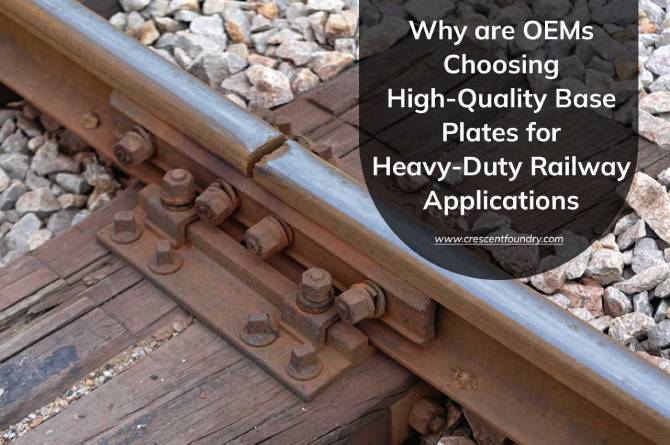
A base plate for railway applications serves as the primary interface between the rail, fastening system, and sleeper. It enables efficient load transfer, maintains rail alignment, and reduces structural stress on track components. With growing performance demands, OEMs now prefer high-quality base plates manufactured by an experienced base plate manufacturer such as Crescent Foundry. Quality manufacturing, material reliability, and long-term durability have become decisive factors in OEM selection.
How do base plates improve load distribution in heavy-duty railway applications?
The distribution of load is the most important performance function of a base plate for railway applications. Heavy freight trains, metro rail systems and high-speed rail systems create continuous and dynamic loads that must be transferred efficiently from the rail foot to the sleeper.
A base plate which has been manufactured to a high level of accuracy will make contact uniformly between the rail foot and the sleeper surface. Because of this uniformity, the load will be distributed over a larger area, thus reducing load concentrations and minimising the chances of degradation. Base plates manufactured to a high level of accuracy give OEMs confidence that the track geometry and structure will remain stable over extended periods of time.
An additional benefit from the use of base plates in railway applications is their enhanced compatibility with today’s newer fastening systems. By providing flatness and accurate dimensions, base plates work well with existing elastic clips, rail pads, and anchor systems. These features enhance the load-transfer capabilities of these systems while minimising wear on the components involved.
Base plates also provide better vibration management for heavy-duty rail operations. Properly seated and aligned, base plates allow the dynamic forces generated during operation to be distributed more efficiently throughout the sleeper, improving the passenger experience in both metro and long-distance travel.
Why Do OEMs Prefer Cast Iron Base Plates for Stability-Critical Applications?
Material selection has a major impact on the performance of the base plate for railway applications. Cast iron has been the material choice for base plates for stable critical railway environments. OEMs claim that a base plate made from cast iron has high compressive strength, excellent dimensional stability, and great vibration-damping characteristics.
Base plates made from cast iron perform excellently under high axle loads without deforming, so they are ideally suited for freight corridors, railway networks, and other used railway lines. An experienced base plate manufacturer produces a base plate made from cast iron that will hold its structural integrity even when pressure is applied to it continuously.
OEMs favour cast iron material base plates because they can inherently absorb and dampen vibrations. The dynamic forces generated by moving trains, brake applications and track irregularities create dynamic vibrations on the rail tracks. By being made up of cast iron, the transmission of these vibrations is reduced to sleepers and substructures of the rail and increases the stability and reduces the noise level of the rail system.
Durability is also a significant reason for OEMs to select cast iron as the primary material to manufacture base plates. Cast iron base plates are very durable regarding wear, fatigue, and exposure to the environment. Base plates that are manufactured by quality base plate manufacturers like Crescent Foundry will be manufactured to a high-quality standard, ensuring a long service life with minimal maintenance.
Also Read: The Importance of Precision in Railway Casting for High-Speed Trains like Vande Bharat Express
Final thoughts
OEMs are under pressure to produce more cost-effective, longer-lasting and safer rail systems. A high-quality base plate is essential to provide the necessary level of safety and effectiveness. The design of the base plate helps to equally distribute the load across the entire length of the vehicle, as well as help to minimise the amount of vibration created by the movement of the trains. In addition, the use of base plates creates stability in the track bed, eliminating issues associated with excessive movement of the rail systems.
Choosing cast iron base plate for railway applications is an important part of ensuring that leading OEMs will have the most suitable products available for use in the heavy-duty railway industry. Cast iron base plates offer an unprecedented level of precision manufacture and material quality that make them a leading choice among global OEMs for their durability and long-term reliability.
FAQs
Q. Why do OEMs prefer cast iron base plates for railways?
A. OEMs prefer cast iron base plates for their high compressive strength, vibration damping, and long-term durability.
Q. What makes Crescent Foundry a reliable base plate manufacturer?
A. Crescent Foundry is a trusted base plate manufacturer with expertise in precision casting and railway-grade cast iron components.
Q. What standards do railway base plates need to meet?
A. A reliable base plate manufacturer like Crescent Foundry produces base plates that meet international railway and OEM quality standards.